



The legend of Saint Plük
Before the stones,
there were trees.
A jack-of-all-trades Gaul, goldsmith and friend of trees, his donkey, an orchard. And a story of generosity that two thousand years have not erased.
CHAPTER 01
A man,
a small plot.
Tradition has it that he was born in the year 77, in a Gaul that Rome had long governed, but which had not quite ceased to be itself. Plük was among the last to live in the Gaulish way: he spoke the language of his forebears, counted the seasons as they did, and kept for trees the ancient respect his people had for them.
But Plük was not content merely to plant: he was a jack-of-all-trades, whose resourcefulness was talked about in the village. By day he worked in a goldsmith’s workshop, where gold and bronze were cast and jewellery was chased. His speciality was fibulae, those clasps that hold cloaks at the shoulder, which he adorned with coral, bronze and gold. The patience of the hand that sets a branch of coral in a thread of gold, he later found again to fit a graft onto a trunk.
All he owned was a narrow plot around his house. Where his neighbours saw a strip of land too thin to matter, he already saw the shade of future foliage.
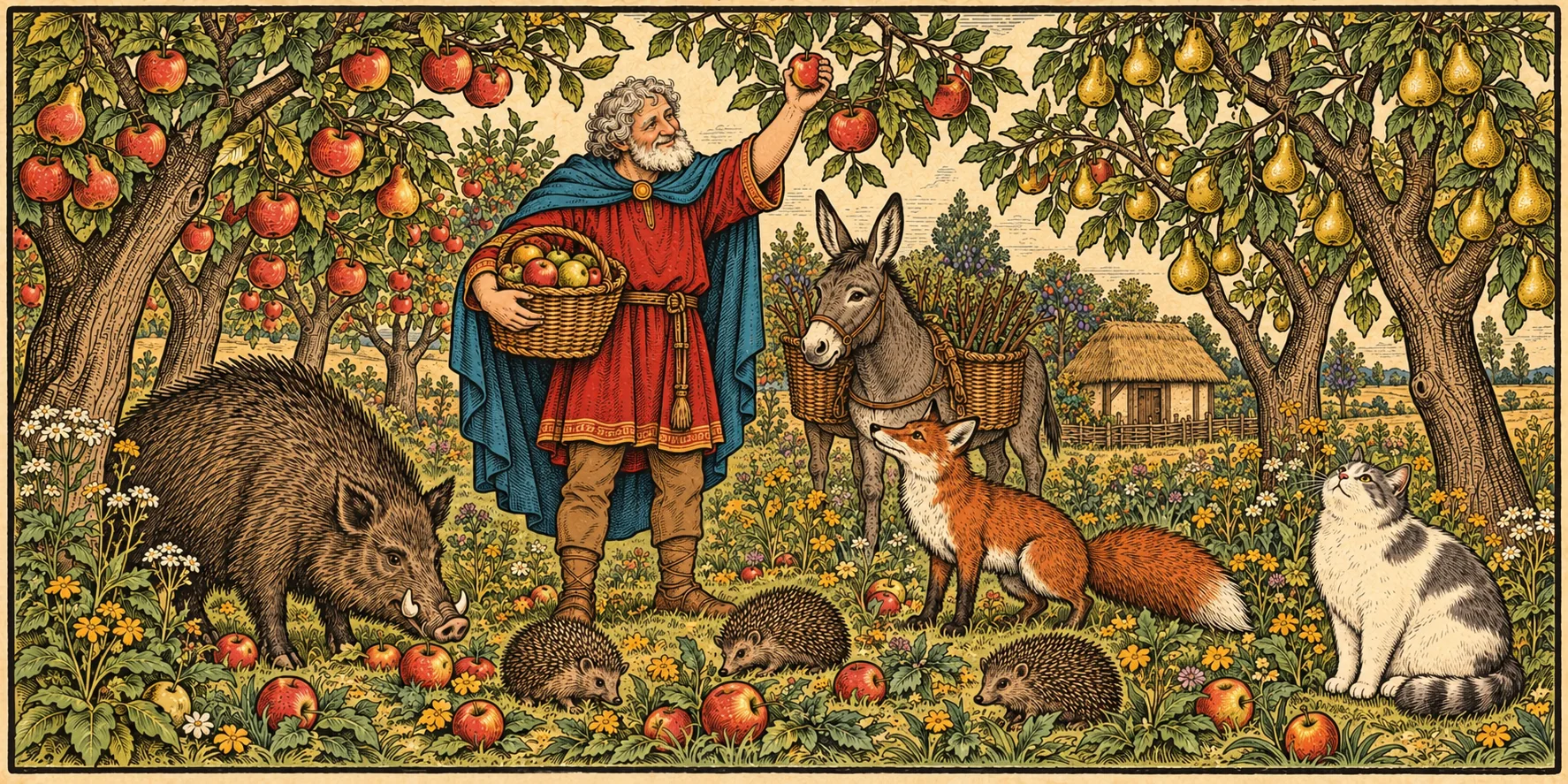
He planted apple trees, pear trees, hazel trees, berry bushes. He planted without haste, the way one writes a long letter whose ending one will never read oneself. Year after year, the plot became an orchard, and the orchard almost a forest.
He was not alone there. Long before the donkey, there was a fox. Plük, still very young, had once found it caught in a trap by its right front paw: he freed it, bandaged the paw and tended the animal until it could run again. Mélo, for that was his name, never left him again: he was his very first friend.
The animals had passed the word: that man could heal some of them. They came at night, quietly, to be tended. That is how he healed a wild boar, and cared for a whole family of hedgehogs. As for the big cat, he had come one evening and never left.
CHAPTER 02
He set off empty-handed.
He came back laden.
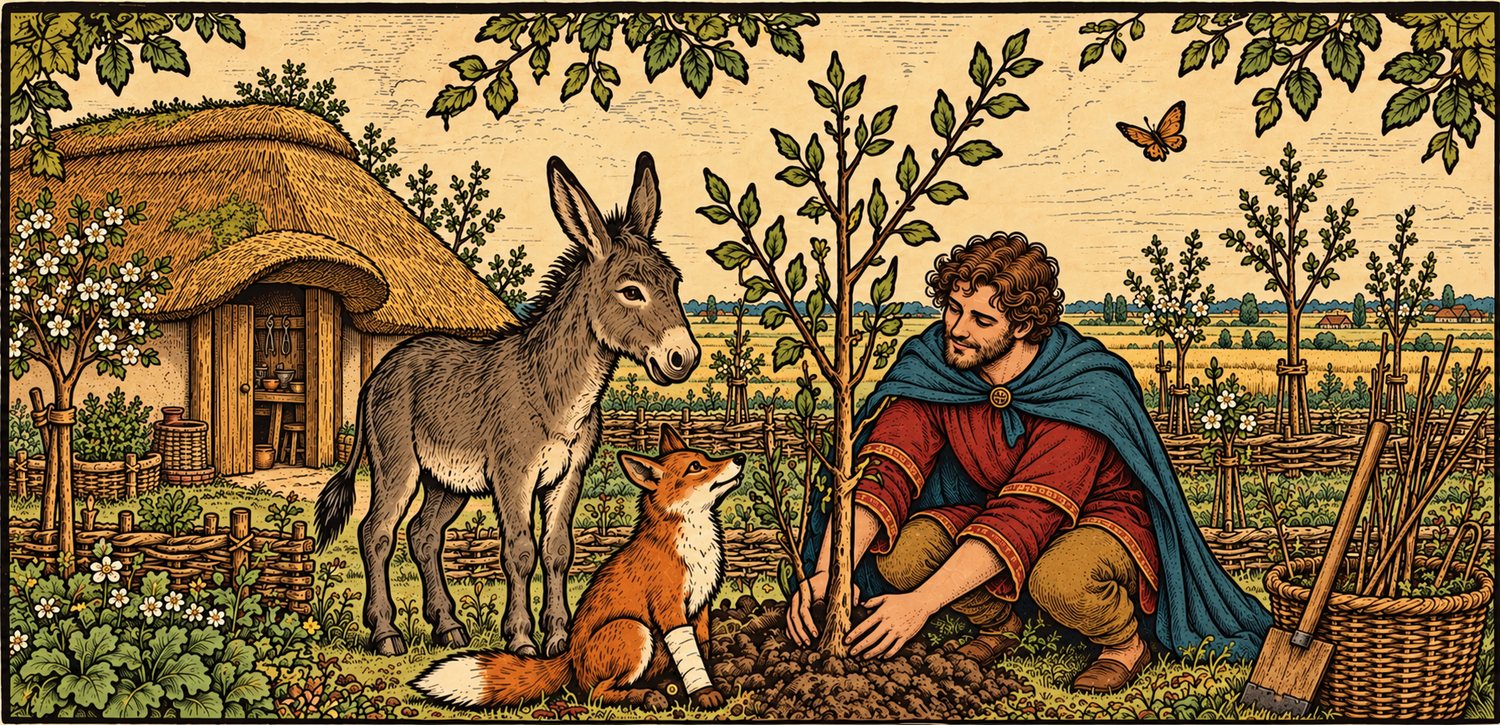
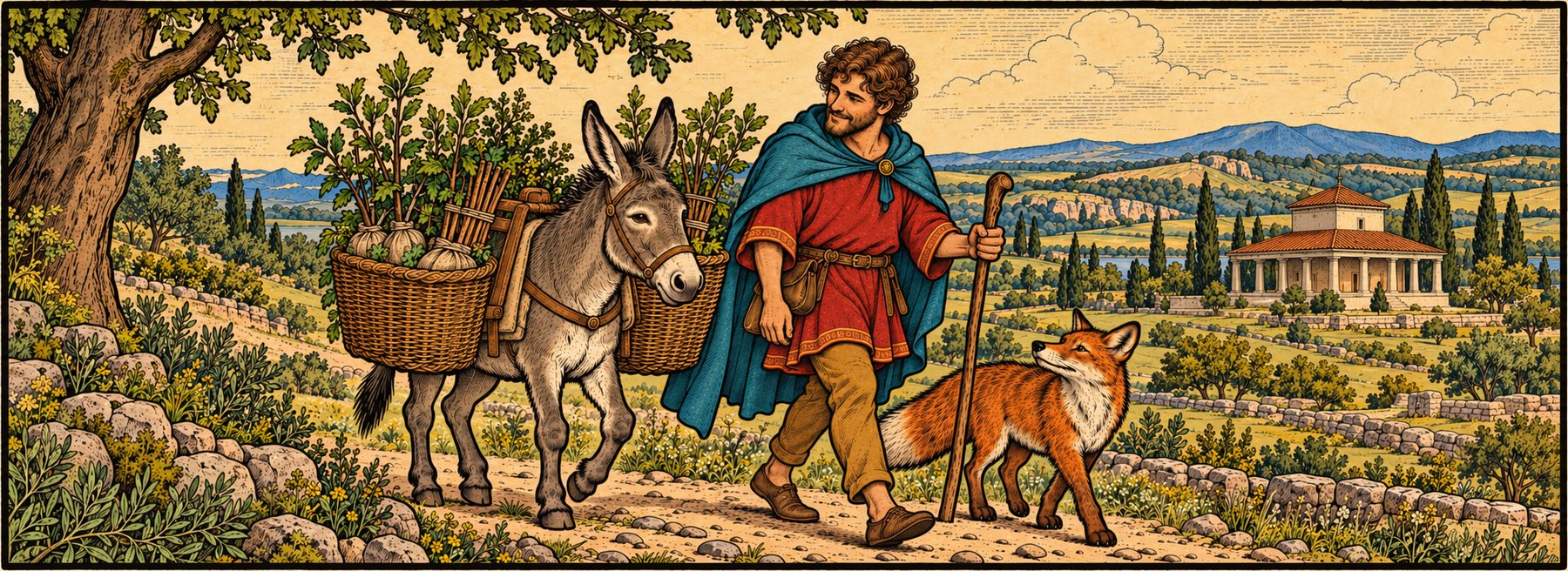
Plük was not one of those whom an orchard is enough to satisfy: he was curious, and every new variety called to him. All who offered to swap a tree found a partner in him, one graft for another, without haggling. Sometimes he set off on short excursions, along paths no traveller had thought to name, and came back with a tree that no one here had ever seen.
He would reappear at the end of the road, his donkey bent under baskets of young saplings, scions wrapped in moss, seeds knotted in cloths. Plük planted them everywhere: in the village, along the lanes, at the corners of fields, where no one would have thought of planting a tree. Around him, people bet on wheat and barley: what was the point of planting trees that would yield nothing for years? They shrugged.
CHAPTER 03
The summer when
the earth cracked.
There came a terrible end of summer, the kind people still speak of in hushed voices. It had not rained for months: the earth had split open, the fields had yellowed where they stood, the game had deserted the forests, the granaries sounded hollow, and those very people who had laughed at his trees came, one evening, to knock at his door, heads bowed.
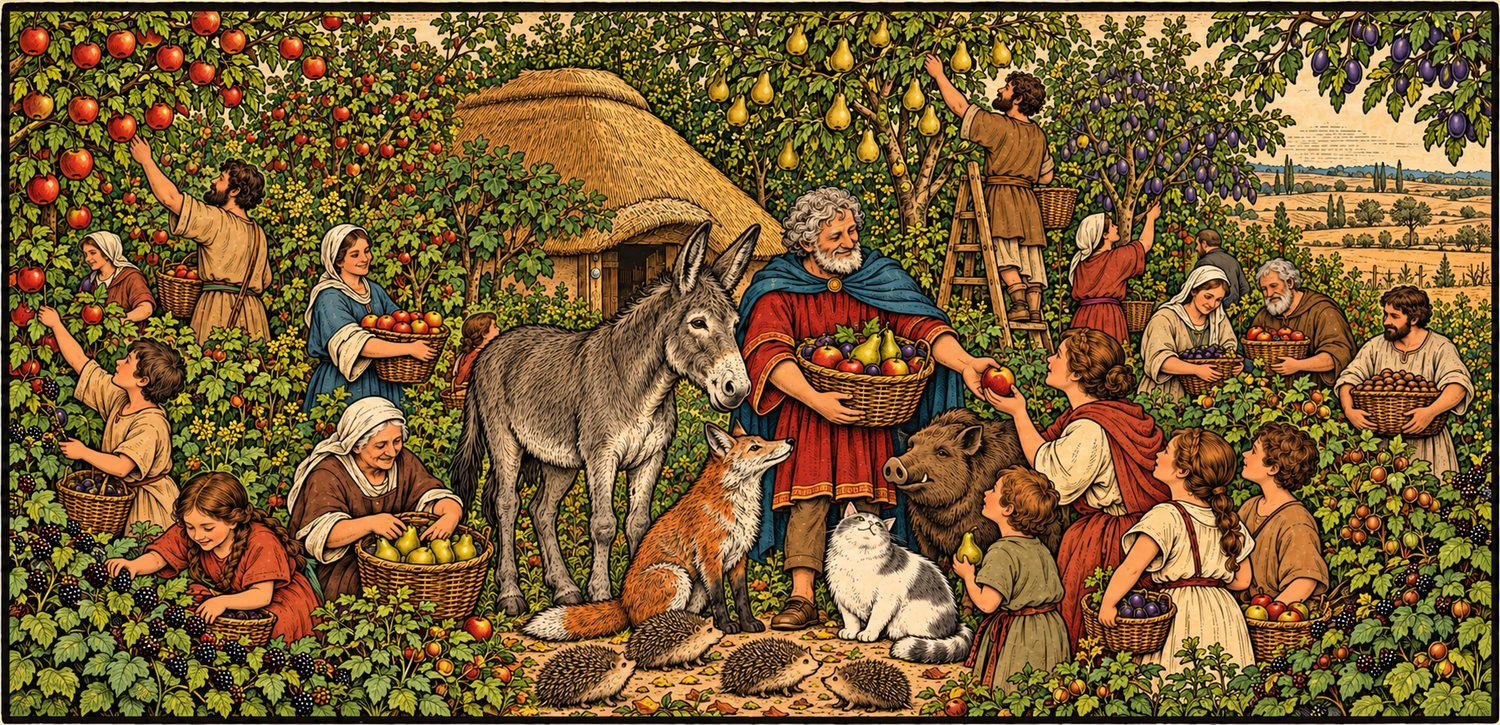
Plük did not take up their mockery. He opened the orchard. His trees, planted close together, held the shade and the coolness of the soil: it is said that he alone still had green grass beneath his apple trees. The branches bent under apples, pears and hazelnuts, and he gave some to everyone. His house was no less open to animals: at Plük’s table sat side by side Mélo, the donkey, a wild boar, hedgehogs and a big cat, without any of them harming another. The village held out until the first rains, and no one forgot who had saved it.
CHAPTER 04
They called him
the gatherer.
No one knows when Plük died, or how. The accounts fall silent, as they do for those who lived better than they left traces. But his trees outlived him for a long time, well after him, and went on feeding those who came to gather in their shade. Little by little, people began to say Saint Plük, the gatherer: a saint of the people, whom no bishop had named, but whom every generation thanked.
Where did his people come from? Here too, tradition hesitates. Some say the North, Scandinavia or Holland, England, the Alps; probably a little of all of these, like those who belong everywhere because the road is their homeland.
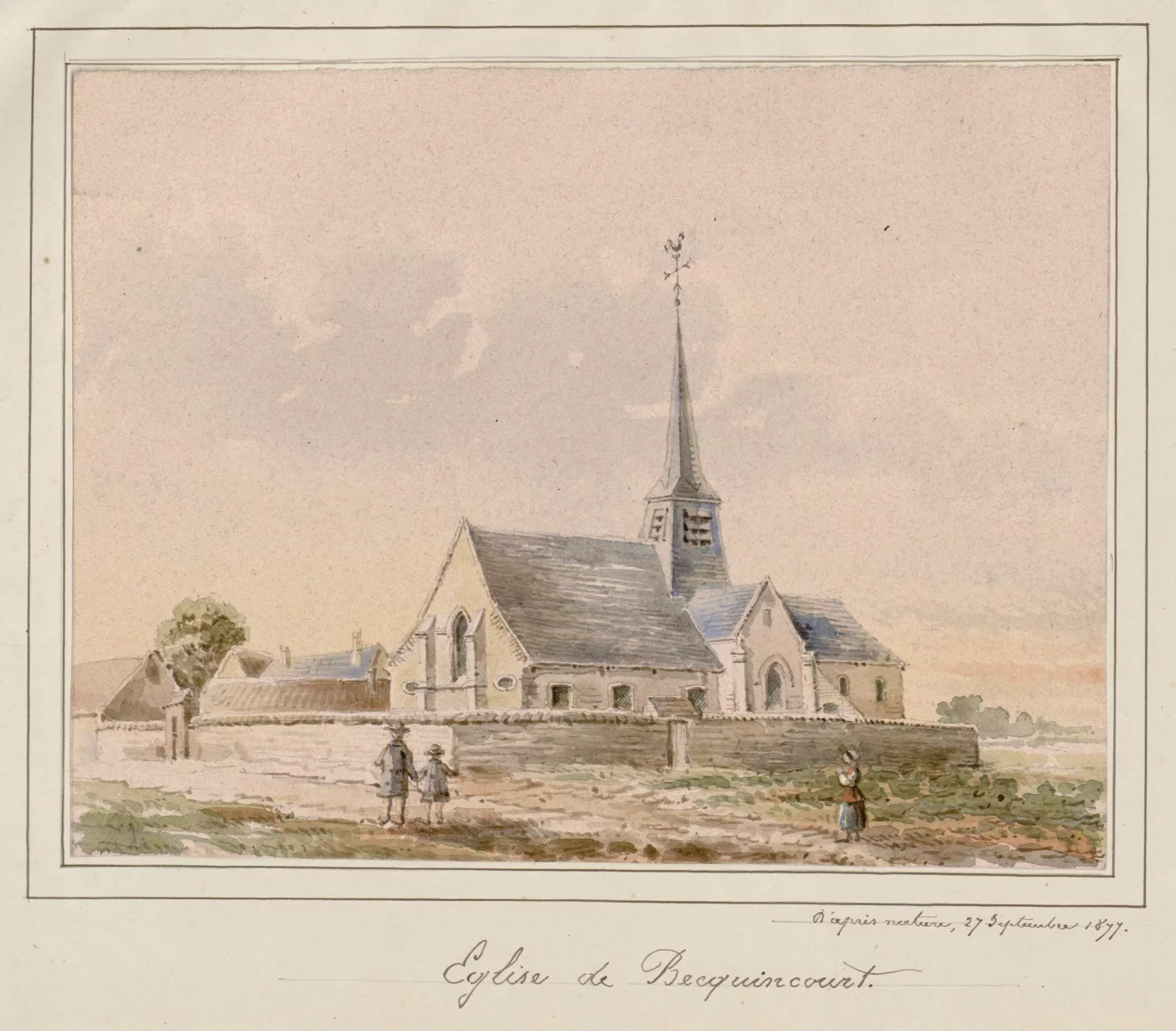
The villagers never forgot him. First they raised a chapel on the very spot where his house and apple trees had stood, then, as the centuries passed, a church, always in the same place, as if to keep together the memory of the man and that of his orchard.
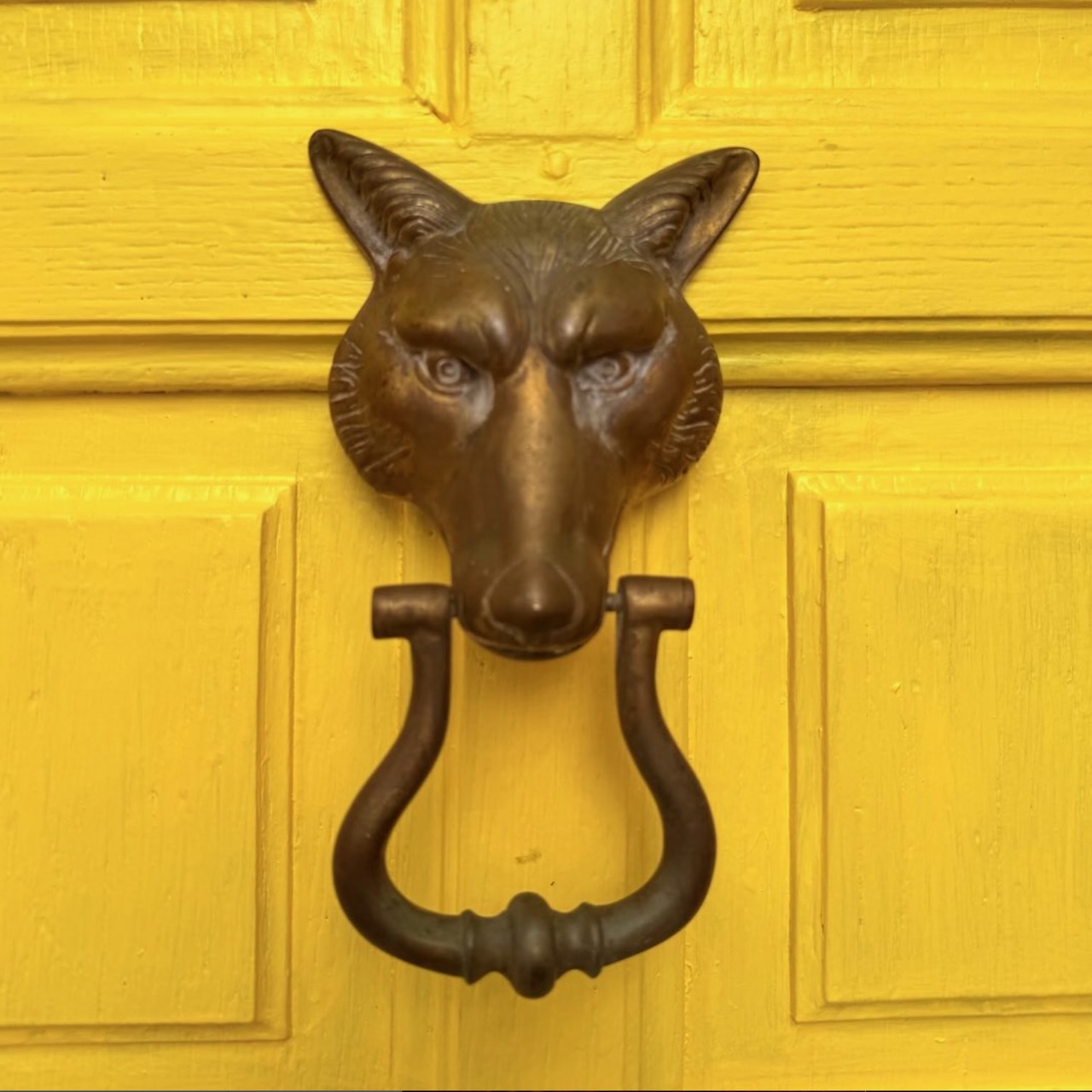
Today, at the entrance of the church, the door is painted yellow: the colour of life, of light and of the energy that comes in with you. To knock, a bronze knocker represents Mélo, Plük’s fox, who guards the threshold and welcomes those who come.
CHAPTER 05
What if we
planted again?
Around Saint Plük, the plain now stretches out in sugar-beet fields as far as the eye can see: few orchards, few hedgerows, little life. And yet the story of Plük could be told tomorrow.
People still come here to be together, share a meal and rest. From trees to stones, one idea: make room for others, and for what grows. And what if, on leaving, you planted a tree?
“The wealth of the place
is what we share in it.”
The legend of Saint Plük