


Walls covered in cement
Unlike traditional lime plasters, cement trapped the damp inside the walls. I removed these unsuitable renders so that the stones could breathe again.

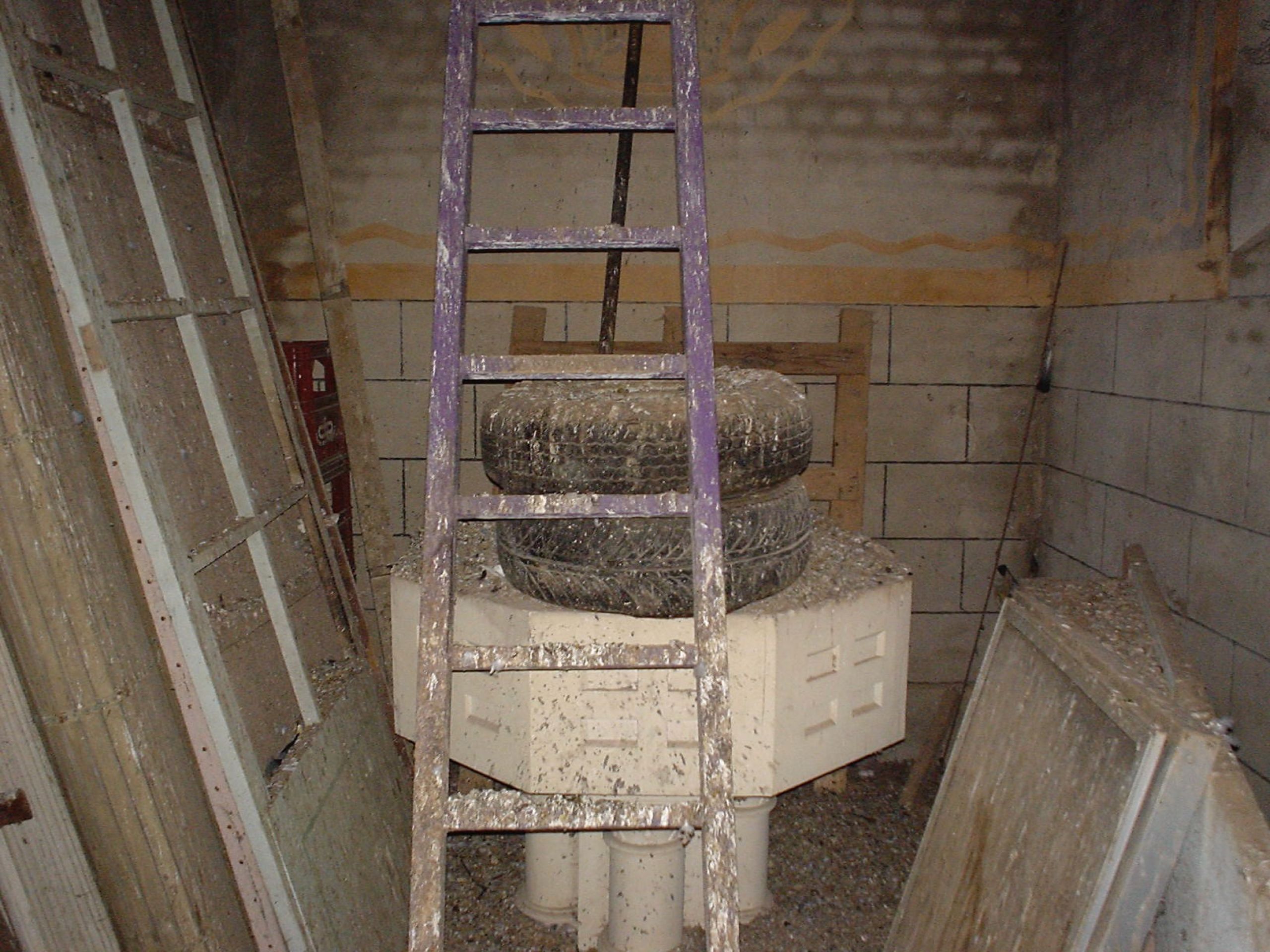
Before the works
The state of the old church after twenty-five years of abandonment, and the first responses given to the building.
THE INITIAL STATE
After twenty-five years of abandonment, the church was in an advanced state of dilapidation. Water was seeping in at several points, the stones were saturated with damp, and many pigeons had made their home in the roof frame. The stained-glass windows had disappeared, replaced by concrete blocks, and the interior was cluttered with all kinds of objects accumulated over the years.
Unlike traditional lime plasters, cement trapped the damp inside the walls. I removed these unsuitable renders so that the stones could breathe again.
Too small, they let water into the bell tower during strong winds or storms. I designed and installed a new, more effective system.
The rainwater drainage was totally inadequate. I installed wider gutters and eaves channels to solve the problem.
I also replaced 4,000 damaged tiles to make the roof completely watertight.
These interventions preserved the structural integrity of the building and secured its future for many years to come.
Photographs kept in the “Before the works” file.
The road travelled
Follow the restoration step by step, then picture your stay.